
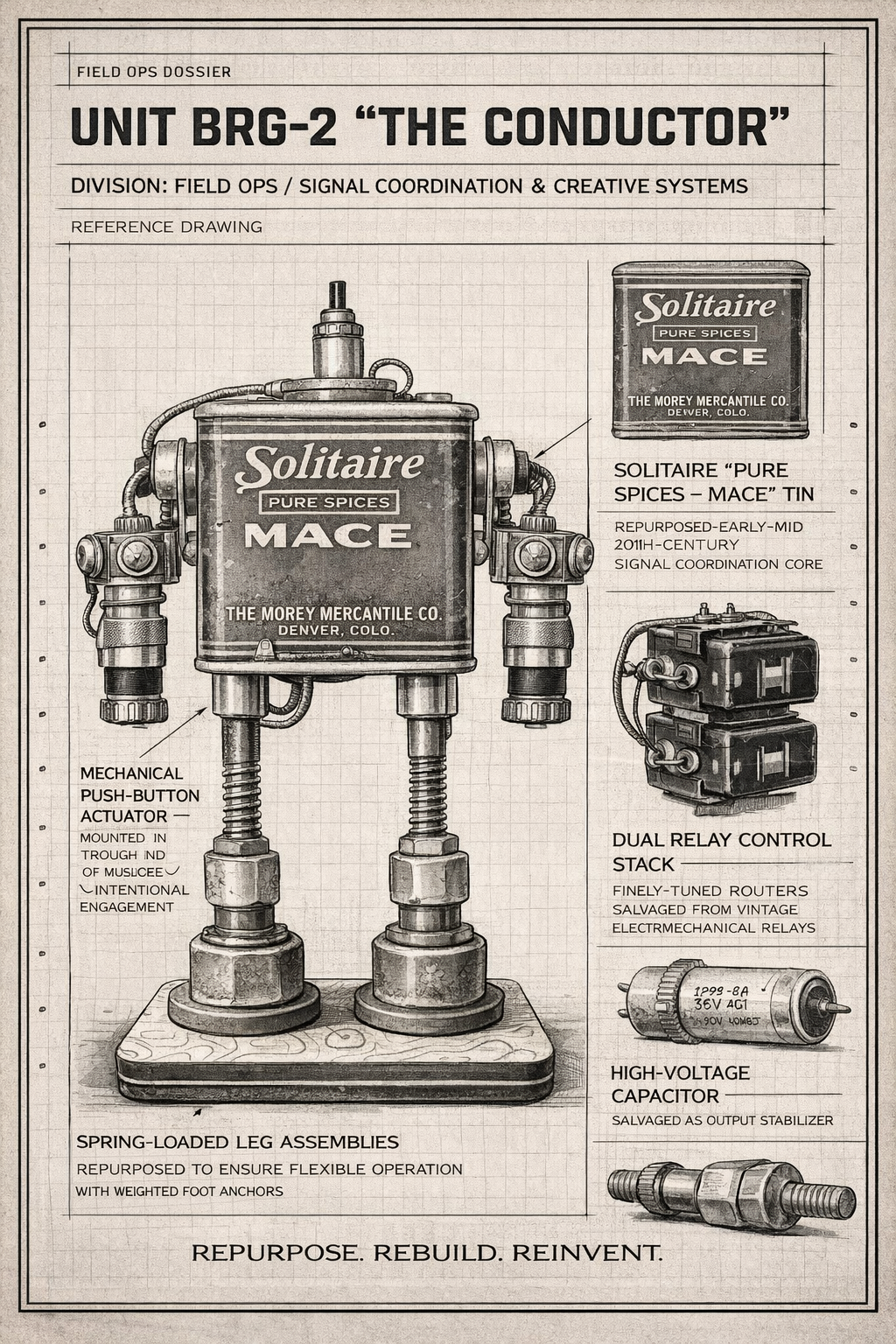
FIELD OPS DOSSIER
UNIT BRG-01 “THE CONDUCTOR”
Division: Field Ops / Signal Coordination & Creative Systems
Operational Status: Active
CORE ORIGIN
Solitaire “Pure Spices – Mace” Tin
Manufacturer: The Morey Mercantile Co., Denver, Colorado
Era: Early–Mid 20th Century
Originally produced to store and preserve delicate spices, the tin was engineered to protect contents from moisture, contamination, and loss of potency. Its rigid construction and tight-fitting lid made it suitable for repeated handling without degradation of what was kept inside.
ORIGIN SUMMARY
Not all systems are built for force.
Some are built for balance.
BRG-01’s core began life as a Solitaire Mace spice tin, a container designed to safeguard subtle but essential elements — materials that could not be rushed, overheated, or mishandled without consequence. In its original role, precision came not from measurement, but from judgment.
When recovered, the tin showed signs of long-term use: softened edges, worn paint, and patina consistent with years of careful handling. Engineers noted that unlike industrial housings designed for impact, this vessel had been shaped by restraint.
Recognizing its potential, the tin was repurposed as a signal coordination core, a place where inputs could be gathered, moderated, and redistributed.
To support this role, the unit was fitted with a dual-relay control stack, constructed from vintage electromechanical relays. These components historically served as decision intermediaries — devices that received multiple inputs and determined when action should occur. In BRG-01, they function as routing nodes, ensuring signals are passed deliberately rather than impulsively.
A high-voltage capacitor was integrated into the core assembly to store and release energy gradually. Rather than amplifying power, it smooths fluctuations, preventing spikes that could destabilize connected systems.
Braided and insulated wiring connects the relays, terminals, and capacitor, creating visible signal pathways. Nothing is hidden. Communication is meant to be understood.
The unit’s upper assembly features a mechanical push-button actuator, mounted directly through the lid. This component allows for intentional engagement — action only occurs when deliberately initiated.
Arm assemblies were built using rotary potentiometer faces, repurposed as tactile interface tools. Originally used to fine-tune levels rather than toggle states, these components allow BRG-01 to adjust flow, volume, and intensity with precision.
The leg assemblies consist of threaded rods, compression springs, and weighted anchors, enabling the unit to remain stable while absorbing vibration and environmental variation. Like the systems it supports, BRG-01 stands firm without becoming rigid.
FIELD MODIFICATIONS
Solitaire Mace tin repurposed as signal coordination core
Dual electromechanical relays installed as routing controls
High-voltage capacitor integrated for energy smoothing
Braided and insulated wiring for visible signal pathways
Mechanical push-button actuator for intentional engagement
Potentiometer-based arm interfaces for fine adjustment
Spring-loaded leg assemblies for stability under variation
CAPABILITIES & FUNCTION
Signal routing and coordination
Energy moderation and spike suppression
Controlled activation and intentional execution
Fine-tuned adjustment of system output
Stability across variable operational environments
PERSONALITY PROFILE
Intentional
Expressive
Grounded
FIELD OPS MANTRA
Set the Tone.
DESIGNATION NOTES
BRG-01 “THE CONDUCTOR” is deployed where clarity, creativity, and coordination must coexist.
It does not overpower systems.
It balances them.
It does not rush output.
It shapes it.
When timing matters and nuance counts,
BRG-01 ensures everything moves in harmony.
Repurpose. Rebuild. Reinvent.